
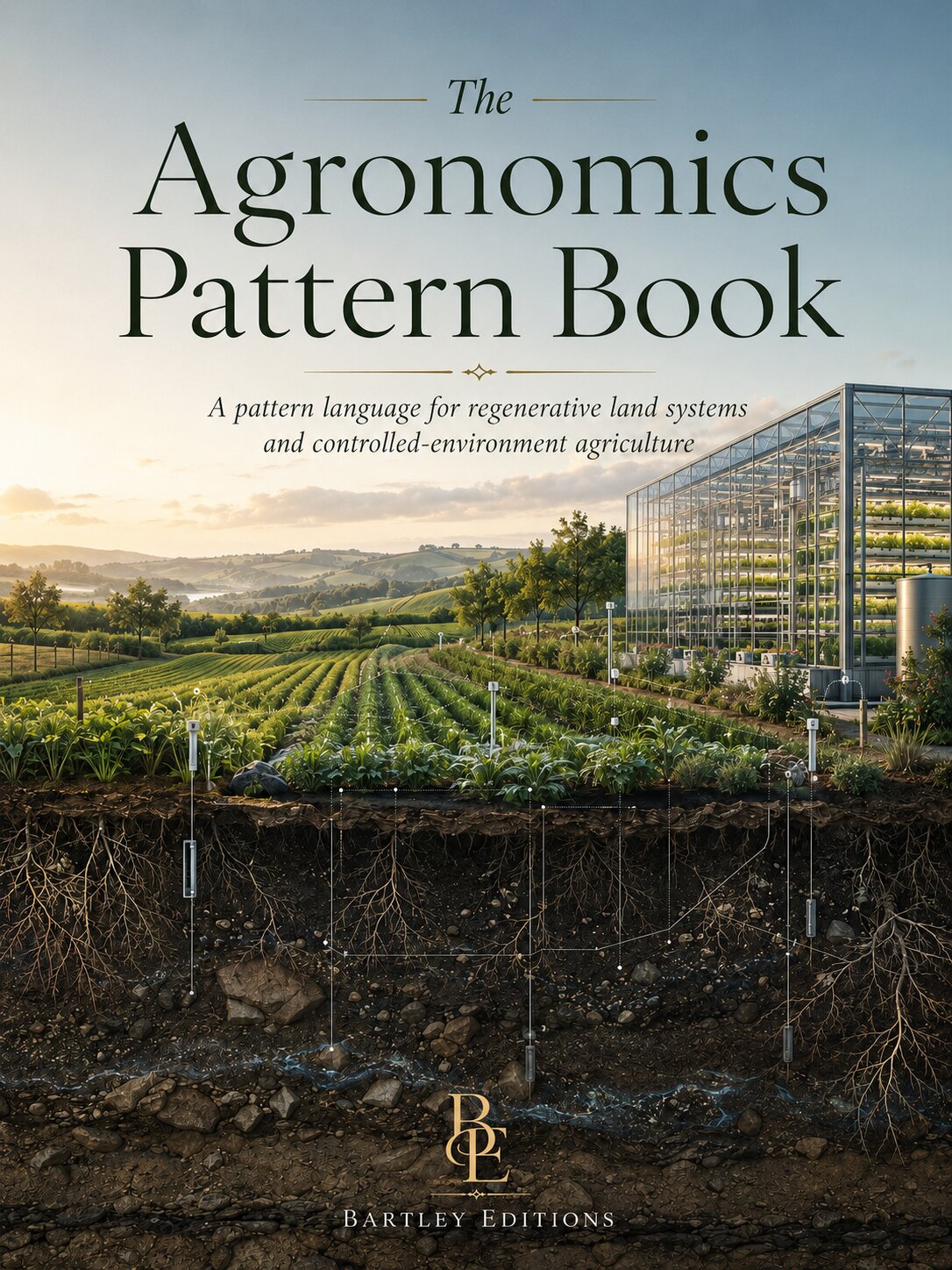
The Agronomics Pattern Book treats agronomics as a portmanteau of agronomy and economics. It catalogs the patterns of food-producing systems that work with biological process rather than against it — open-field regenerative practice at one end of the spectrum, controlled-environment agriculture at the other — and the bridging mechanisms that translate biological practice into capital flow and market access: financing structures, measurement protocols, traceability systems, certification regimes.
Most existing references treat the two halves separately: a soil-science textbook on one shelf, a transition-finance white paper on another. The bankability gap that holds back regenerative adoption, and the unit-economics failures that have flattened the first generation of vertical-farming companies, are both failures of integration between the biological pattern and the capital pattern. This book catalogs both and shows where they meet.
The form is Christopher Alexander’s A Pattern Language and the Gang of Four’s Design Patterns, applied at the level of editorial and citation rigor the field has been missing. Each entry is a named pattern, antipattern, or concept with consistent anatomy: context, problem, forces, solution, examples with named operators and dates, sources, and links to related entries.
Browse the Encyclopedia
Introduction — Food production now has to prove that biological performance and economic survival can hold together. A soil-health practice that cannot carry transition risk will stall. A vertical farm that produces clean greens at a cost the market won’t pay will fail. A carbon claim without measurement is sales copy. The Agronomics Pattern Book is a pattern language for that combined field: regenerative land systems, controlled-environment agriculture, and the measurement, standards, and finance that make either one legible. Includes What’s New, Article Map, and more. View all 2 entries →
Soil and Living Systems — The biological substrate. The patterns and concepts that govern what happens beneath the surface — soil structure and biology, plant-soil feedbacks, microbial communities, water cycling, and the management practices that work with the substrate rather than against it. Includes Soil Organic Carbon, The Soil Food Web, Biological Nitrogen Fixation, Microbial Nitrogen Biofertilizers, Sprayable RNAi (dsRNA) Biopesticides, and more. View all 14 entries →
Field and Landscape Patterns — The visible operating layer of regenerative agriculture. Cover cropping, rotations, agroforestry, silvopasture, integrated livestock, water harvesting, keyline design — the patterns that show up at the field, paddock, and landscape scale. Includes Crop Rotation, Intercropping and Polyculture, Alternate Wetting and Drying Rice, Perennial Grains (Kernza), Holistic Planned Grazing, and more. View all 21 entries →
Controlled-Environment Systems — Indoor and protected-cropping production. Hydroponics, aquaponics, aeroponics, greenhouse engineering, vertical-farm architectures, environmental controls, plant lighting, crop steering. Includes Controlled-Environment Agriculture (CEA), Hydroponics, Aeroponics, Aquaponics, Daily Light Integral (DLI), and more. View all 13 entries →
Measurement, Traceability, and Data — The instruments, protocols, and information systems that quantify outcomes. Soil-carbon MRV pipelines, ecological-outcome verification, remote sensing, digital twins, blockchain traceability, sensor networks, life-cycle assessment, nutrient-balance indicators. Includes Soil Carbon MRV Pipeline, Ecological Outcome Verification (EOV), Soil eDNA and Metabarcoding, Outcome-Based vs Practice-Based Standards, Remote Sensing for Agriculture, and more. View all 12 entries →
Certification and Standards — The labels and frameworks that translate practice into market access. Regenerative Organic Certified, Land to Market / EOV, USDA Organic, GLOBALG.A.P., FSMA, ISO 22000 family, Demeter biodynamic, fair-trade overlays. Includes Regenerative Organic Certified (ROC), Land to Market and EOV Sourcing, USDA Organic, EU Carbon Removals and Carbon Farming (CRCF), GLOBALG.A.P., and more. View all 8 entries →
Finance and Business Models — Where capital meets ecology. Blended finance, catalytic capital, sustainability-linked loans, ecosystem-service payments, offtake agreements, soil-carbon credit markets, transition-finance structures, CEA unit economics. Includes Bankability Gap, Sustainability-Linked Loan, Parametric Crop Insurance, Groundwater Markets, Blended Finance, and more. View all 14 entries →
Policy and Food Systems — The institutional context. USDA conservation programs, EU CAP, FAO/IPCC frameworks, true cost accounting, food-sovereignty principles, federal-state-tribal coordination. Includes USDA Conservation Reserve and EQIP, EU CAP and Eco-Schemes, Food Sovereignty, Agroecology, Hidden Costs of Agrifood Systems, and more. View all 7 entries →
Heuristics and Antipatterns — The recurring traps and the seasoned-operator rules of thumb. Regenerative-washing, the “build the showcase facility first” CEA bust, carbon-credit permanence theater, vendor-locked traceability, transition-yield-drag denial, single-practice regenerative claim. Includes Regenerative-Washing, Build the Showcase Facility First, Carbon-Credit Permanence Theater, Vendor-Locked Traceability, Transition-Yield-Drag Denial, and more. View all 6 entries →